
When a project is running behind or a deadline is not moving, engineers need boards fast. Quick turn PCB assembly is the service that covers this situation. It combines board fabrication, component sourcing, and full SMT assembly into one accelerated workflow, with finished boards delivered in days rather than weeks.
But quick turn assembly is more than just moving faster through the standard production steps. Done properly, it requires careful file preparation, accurate BOM data, responsive engineering support, and a supplier whose quality process does not change based on how urgent your order is.
This article explains how quick turn PCB assembly works, what determines whether you actually get your boards on time, what the production process looks like at each stage, and how to choose a supplier who can deliver on the timeline they quote.
What Quick Turn PCB Assembly Is
Quick turn PCB assembly is a manufacturing service that delivers fully assembled printed circuit boards on an accelerated schedule. Unlike standard lead times of 10 to 20 business days, quick turn services aim to deliver within 3 to 7 business days for most designs, and within 24 to 72 hours for simpler builds when components are in stock.
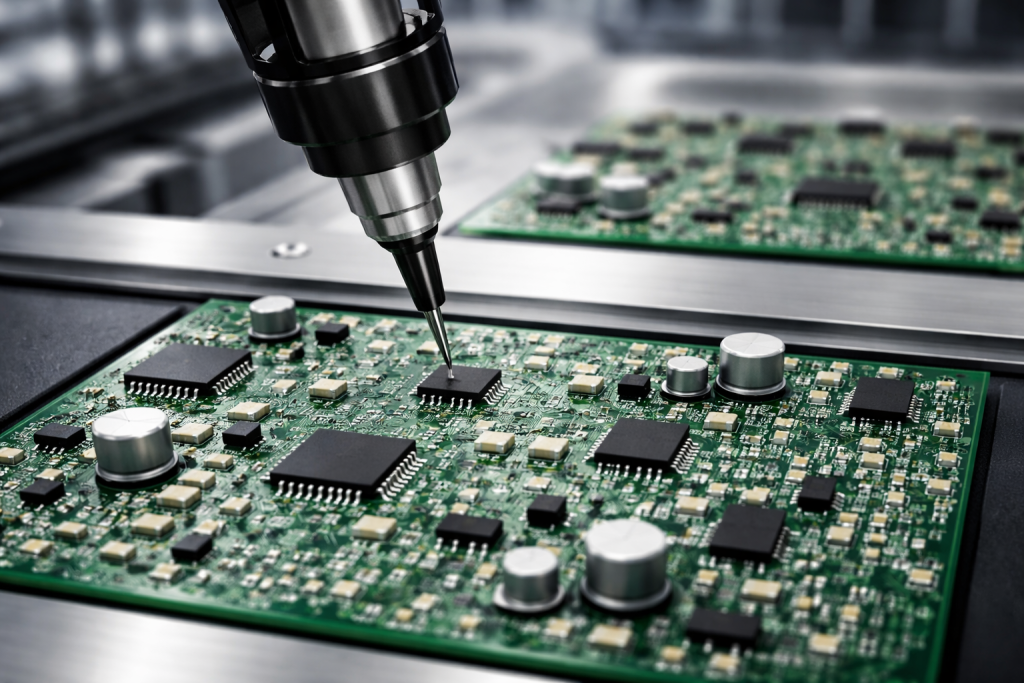
The assembled board you receive has gone through every production stage: bare board fabrication, component procurement from authorized distributors, solder paste application, automated pick-and-place, reflow or wave soldering, automated optical inspection, and where specified, functional testing. It is not a reduced-process shortcut. It is the same process run on a prioritized production schedule.
Quick turn assembly differs from standard assembly in three ways: production priority is higher, engineering reviews happen faster, and BOM sourcing is handled more urgently. The materials and equipment are the same.
Why Teams Use Quick Turn Assembly
Quick turn PCB assembly is used across a range of project situations. Some are urgent, some are simply planned around faster iteration cycles.
Prototype validation
Developing a new product requires building and testing physical boards. The faster each prototype cycle completes, the faster you can identify problems and release a corrected version. Teams that use quick turn assembly for prototype iterations typically get more revision cycles done in a given development window, which leads to better products at launch.
Pre-production checks
Before committing to a full production run, many teams order a small assembled batch for final design verification. These boards need to be close to production quality but delivered fast enough to fit into the project schedule before the production order is placed.
Deadline-driven events
Product demonstrations, investor reviews, regulatory submissions, and trade shows all run on fixed dates. If your board schedule slips, the event does not. Quick turn assembly gives teams a way to recover from schedule pressure without canceling or delaying those commitments.
Field failures and replacements
When a board failure occurs in a deployed product, replacement boards are needed as soon as possible. A quick turn supplier can produce a small quantity of replacement assemblies within a few days, limiting downtime and customer impact.
Parallel development tracks
Some engineering teams run multiple design variants at the same time to compare performance or evaluate alternative component choices. Quick turn assembly lets multiple versions be built and tested within the same time window rather than sequentially.
The Quick Turn PCB Assembly Process
Understanding what happens at each stage of production helps you prepare files correctly and set accurate internal timelines.
File submission and engineering review
You submit your Gerber files, BOM, pick-and-place centroid file, and any assembly notes through the order portal. The engineering team reviews everything before production starts. They check for missing layers in the Gerber package, BOM part number errors, mismatches between the centroid file and BOM reference designators, and any manufacturability issues that could cause problems during assembly.
This review step is where most order delays originate. A BOM with incomplete part numbers, a missing centroid file, or Gerber data without soldermask layers will trigger an engineering query that pauses production until resolved. Spending extra time on file preparation before submission is the most reliable way to protect your lead time.
Component sourcing
The procurement team sources all parts on your BOM from authorized distributors. FastTurn PCB works with distributors including Digi-Key, Mouser, Arrow, and Avnet. Components arrive with full traceability documentation. If any part is unavailable, the engineering team will contact you with verified alternative part numbers and datasheets for your approval before substituting.
Component availability is the largest variable affecting turnaround time on assembled orders. Parts that are in stock at major distributors can arrive at the factory within 24 hours. Parts on allocation or with long manufacturer lead times can delay an order by days or weeks regardless of production priority. Submitting your BOM early and asking your supplier to check stock before you place the order saves significant time.
PCB fabrication
The bare board is fabricated from your Gerber files in parallel with component procurement. Fabrication covers the full process: inner layer imaging, lamination, drilling, copper plating, outer layer imaging and etching, soldermask application, surface finish, and electrical testing of the bare board. Standard surface finishes including HASL and ENIG are fastest. Specialty finishes or non-standard board materials add time.
Running fabrication and component sourcing simultaneously is one of the main reasons quick turn turnkey assembly can deliver faster than managing the two processes separately yourself.
Solder paste application and inspection
A stainless steel stencil matched to your board layout is used to deposit solder paste onto the component pads. After paste application, Solder Paste Inspection equipment checks paste volume and alignment across the board. Insufficient or misaligned paste is one of the leading causes of soldering defects, so this inspection step happens before any components are placed.
Automated pick-and-place
Pick-and-place machines position SMT components onto the solder pasted pads using the centroid data from your pick-and-place file. FastTurn PCB’s SMT factory can handle 0201 and 01005 passive components, BGA, QFN, CSP, and LGA packages. Placement accuracy and nozzle selection are automatically adjusted based on component type.
Reflow soldering
The populated board moves through a reflow oven with a temperature profile calibrated to the solder paste specifications and board thermal requirements. The paste melts and forms solder joints, then cools to a solid connection. Profile optimization matters for boards with a mix of large and small thermal masses or for assemblies with temperature-sensitive components.
Through-hole assembly
If your design includes through-hole components such as connectors, electrolytic capacitors, or discrete through-hole parts, these are inserted and soldered after the SMT process completes. Wave soldering handles most through-hole work. Selective soldering is used for boards where wave exposure would damage nearby SMT components.
Automated optical inspection and X-ray
Every assembled board goes through 3D automated optical inspection. AOI checks component placement accuracy, polarity, solder joint shape, and detects missing or misplaced components. For boards with BGA, LGA, or other hidden-joint packages, X-ray inspection verifies solder ball formation and joint integrity under the component body where AOI cannot see.
Testing
Depending on your specifications, boards can go through flying probe testing, in-circuit testing, functional testing, burn-in, or programming. Test coverage and documentation requirements vary by application. For medical and industrial applications where IPC Class 3 standards apply, more extensive testing and documentation are standard. All test results are recorded and shipped with the order.
Final packaging and delivery
Boards are packed in ESD-safe bags or trays, with moisture-sensitive packaging used where required. Shipment includes the assembled boards, test documentation, and any certificates required by your quality system. Direct shipment to a fulfillment center or downstream manufacturing partner can be arranged.
What the Lead Time Actually Depends On
Quick turn suppliers quote lead times, but the actual time from order placement to delivery depends on several factors that are worth understanding before you commit to a deadline.
Component availability
This is the most significant variable. If every part on your BOM is available at a major distributor and can ship overnight, a turnkey assembled prototype can realistically be completed in 3 to 5 business days. If one critical part is on a 10 day distributor lead time, your assembly cannot ship until that component arrives regardless of how fast the rest of the process moves.
File completeness
Orders with complete, error-free files move into production immediately. Orders with file problems go into an engineering query queue and wait for your response. If a query is raised at 5 PM and you respond the next morning, you have already lost most of a business day.
Board complexity
Standard 2 to 4 layer rigid FR4 boards with common components and ENIG or HASL surface finish move fastest. Multilayer boards, HDI with blind or buried vias, specialty materials, fine-pitch components at high density, or boards requiring custom test fixtures all add time relative to a straightforward design.
Quantity
Prototype quantities of 1 to 10 boards move through production faster than runs of 50 to 500. Larger quantities require more machine setup time, more component stock to be organized, and longer inspection windows. Quick turn timelines of 24 to 72 hours apply to small prototype quantities. Larger production runs have correspondingly longer but still accelerated schedules.
Surface finish and special processes
HASL lead-free and ENIG are the fastest surface finishes for fabrication. Immersion silver, immersion tin, hard gold, and carbon ink add process time. Any requirement outside a supplier’s standard capability, including special soldermask colors, thick copper, or specific impedance control tolerances, adds lead time.
Files You Need to Prepare
Preparing a complete and accurate file package is the most controllable way to protect your lead time. Here is what FastTurn PCB requires for a quick turn assembly order:
- Gerber files in RS-274X format covering all copper layers, inner layers for multilayer boards, top and bottom soldermask, top and bottom silkscreen, board outline, and drill data including mechanical and via drill files
- Bill of Materials in Excel or CSV format with manufacturer part numbers, quantities, reference designators, package descriptions, and any preferred substitutes or do-not-install designations clearly marked
- Pick-and-place centroid file with reference designators, X and Y coordinates, rotation values, and top or bottom side designation for each component
- Assembly drawings or notes covering polarity requirements, special handling instructions, conformal coating areas, test specifications, or any requirement not visible in the Gerber or BOM files
The single most common cause of delays on quick turn orders is an incomplete BOM. Part numbers listed as internal reference numbers instead of manufacturer part numbers, missing quantities, or BOM entries that do not match the reference designators in the Gerber files all trigger engineering queries that pause production.
Quality Standards That Apply to Quick Turn Orders
A recurring concern with fast turnaround is whether accelerated production means reduced quality. At FastTurn PCB, the quality process is the same for quick turn orders as for standard lead time production.
Every board goes through 100 percent inner and outer layer automated optical inspection during fabrication, electrical testing of the bare board, SPI before component placement, 3D AOI after reflow, and X-ray inspection for hidden joint packages. The certifications covering this process include ISO 9001, ISO 13485, UL, RoHS, and REACH. Assemblies follow IPC Class 2 or Class 3 standards depending on your specifications.
What changes in a quick turn order is production scheduling priority. Boards are moved to the front of the production queue. The inspection and testing steps do not change.
Practical Turnaround Reference for Common Build Types
Here are realistic lead times for common build types when files are complete and components are in stock:
- Simple 2 layer boards with in-stock components: 72 hours from order confirmation to ship
- Standard 4 layer assemblies with moderate component count: 3 to 5 business days
- Complex multilayer boards with 6 or more layers: 5 to 8 business days
- HDI boards with blind or buried vias: 7 to 10 business days depending on layer count
- High frequency boards on Rogers or similar laminates: 5 to 7 business days subject to material availability
- Flex and rigid-flex assemblies: 7 to 15 business days depending on construction
For orders where components require distributor lead times beyond 2 to 3 days, the assembly timeline extends accordingly. Confirming component availability before placing the order is always worth doing.
How to Choose a Quick Turn PCB Assembly Supplier
Choosing the right supplier matters more when timelines are tight than when they are not, because there is no time to recover from a supplier who cannot deliver what they quote.
In-house fabrication and assembly under one roof
A supplier who handles both fabrication and assembly in their own facilities can run both processes in parallel and has direct control over scheduling. Suppliers who outsource fabrication or assembly to a subcontractor add handoff time and introduce coordination uncertainty that can affect your actual delivery date. FastTurn PCB owns both its PCB fabrication factory and its SMT assembly factory.
Engineering review before production starts
Any competent quick turn supplier reviews your files for errors before cutting boards or ordering components, not after. Ask prospective suppliers how they handle BOM discrepancies or Gerber issues and how quickly they respond to engineering queries. The faster they catch and communicate problems, the less time you lose.
Transparent component sourcing
The supplier should source components only through authorized distributors and provide traceability documentation on request. Counterfeit components are a real problem and become more likely when time pressure leads buyers to grey market sources. A supplier with clear authorized-only sourcing policies protects you from this risk.
Real customer feedback with specifics
Look for customer reviews that mention specific lead times, communication quality, and board quality rather than just generic satisfaction ratings. FastTurn PCB has served more than 100,000 customers since 2015 and maintains a positive feedback rate above 98 percent.
Responsive engineering support
On a tight timeline, how quickly your supplier answers a component substitution question or a file query directly affects when your boards ship. Test their response time before you are in a time-sensitive situation.
Conclusion
Quick turn PCB assembly is a practical tool for development teams who need to work faster. The service covers the complete production process from file review through fully tested, assembled boards, delivered on a priority schedule.
Getting your boards on the timeline quoted depends on three things you control: submitting complete and accurate design files, providing a BOM with real manufacturer part numbers and verified component availability, and choosing a supplier with in-house fabrication and assembly capability who reviews your files before starting production.
When those conditions are met, a 3 to 7 day turnaround on fully assembled prototypes is realistic for most designs, and 24 to 72 hours is achievable for simpler builds with in-stock components.
To request a quote or check component availability for your next design, visit quick turn PCB assembly services at FastTurn PCB and upload your files for a same-day engineering review.