When people start looking at internal doors seriously, really looking, beyond just picking something that fits the opening, they often end up at steel. It’s not always where they expected to land. A lot of homeowners start with timber, discount uPVC fairly quickly, and then stumble onto steel french doors almost by accident. And then they can’t quite work out why they didn’t look here first.
The appeal is straightforward once you understand it. Steel combines a level of durability that other door materials genuinely can’t match with a design quality that suits a wide range of interiors, from a stripped back warehouse conversion to a carefully restored Edwardian semi. It’s not a niche material or a specialist choice. It’s simply the best option for a lot of homes, and it’s worth understanding why.
The Durability Case: Why Steel Outlasts Everything Else
Let’s start with what steel actually does that other materials don’t.
Timber has warmth and character but it’s fundamentally a natural material, which means it responds to its environment. British weather, the damp winters, the central heating running for months on end, the humidity fluctuations, puts timber under constant stress. It swells in wet conditions. It shrinks when it dries out. Over time, doors start to bind in their frames, gaps appear where they shouldn’t, and the precision of a well fitted door begins to degrade. This isn’t a failing of low quality timber, it happens with the good stuff too. It’s just the nature of the material.
uPVC avoids that problem but introduces others. The profiles are bulky because the material needs volume to achieve strength. The finish can yellow or fade over years of exposure. And there’s a plasticky quality to it that tends to look worse as it ages rather than better. In a home where you’ve invested in the details, uPVC rarely holds up its end of the bargain aesthetically.
Steel doesn’t warp. It doesn’t swell or shrink. It doesn’t degrade in the way organic materials do. A steel door frame that’s been properly powder coated will hold its shape, its tolerance, and its finish for decades without demanding much from you in return. That’s not marketing language, its just physics. The material is dimensionally stable in a way that timber can never fully be.
For internal applications, this matters more than people sometimes assume. Internal doors are used constantly. They’re opened and closed hundreds of times a year, in rooms that go through significant temperature and humidity changes. The door that felt perfect on installation day needs to still feel perfect five, ten, fifteen years later. Steel gives you that consistency in a way that’s genuinely difficult to replicate with other materials.
Slim Profiles and the Light Advantage
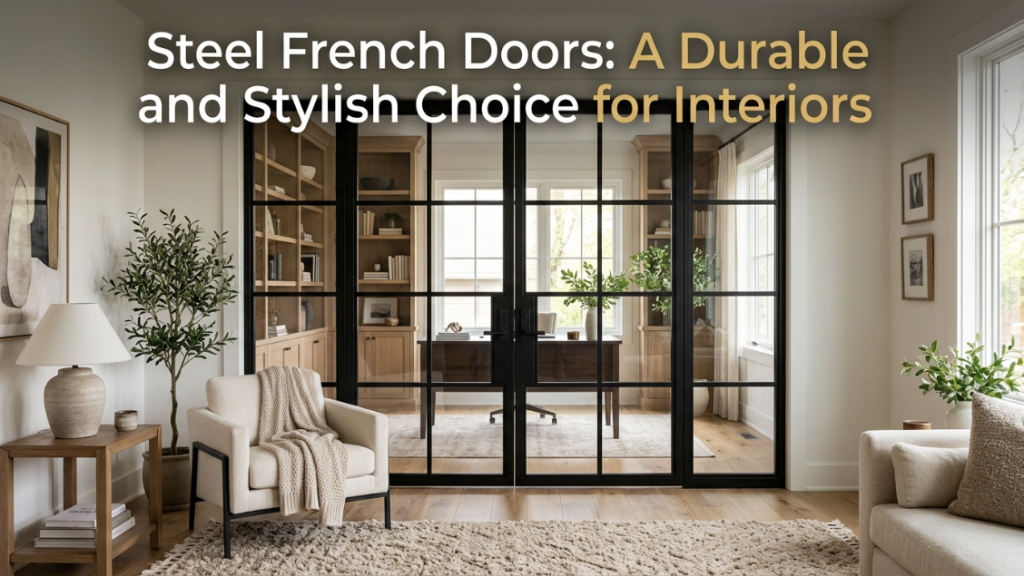
One of the things that surprises people when they first see quality steel french doors in person is how much glass there is. The frames are remarkably slim. Where a timber door might have a frame depth of 70mm or more, a well engineered steel profile can achieve the same structural performance at 30 to 40mm. That’s not a marginal difference, it’s a completely different visual proportion.
More frame means less glass. Less glass means less light. In a typical UK home, particularly a terraced property or a flat where natural light is already working hard to reach the interior rooms, that trade off matters enormously. Steel french doors tip it decisively in the right direction.
The effect is most obvious when you’re standing in a room and looking at the doors as part of the overall composition. Chunky timber frames pull attention to themselves. Slim steel profiles recede and let the glass, and whatever is on the other side of it, do the visual work. The room feels less interrupted. Light moves more freely. And the architectural quality of the doors reads as considered rather than imposed.
Black Steel Doors are built around this principle. The frames are engineered to be as slim as the material and the structural requirements allow, which means the glazed area is maximised and the doors do what internal french doors with glass are supposed to do: bring light in and make spaces feel connected.
Style That Doesn’t Date
Durability is one half of the argument. Style is the other, and it’s worth being honest about what “stylish” actually means in the context of a long term investment in your home.
A lot of interior choices that feel current and exciting quickly start to look dated. Trends move fast, and something that looked fresh three years ago can feel tired now. This is one of the reasons it’s worth thinking carefully about doors specifically, they’re not something you replace every few years the way you might update a sofa or repaint a wall. They live in your home for a long time, and they need to hold up over that stretch.
Steel has an advantage here because its appeal isn’t rooted in trend. The material has been used in architectural applications for well over a century. The combination of slim metal frames and large glass panes is associated with Crittall windows, industrial loft conversions, Georgian orangeries, and contemporary extensions in equal measure. It belongs in multiple eras and multiple aesthetic contexts simultaneously. That’s a quality that genuinely does not date.
The finish colour is a choice that deserves some thought. Black is by far the most popular option and it works almost universally, in a period property it feels authoritative, in a contemporary space it feels graphic and clean. Dark greens and charcoals are worth considering if you want something with a bit more warmth or individuality. Whatever you choose, a high quality powder coat finish on steel holds colour far better than paint on timber, which means the doors look the same in year ten as they did on day one.
Hardware matters too and its not always given the attention it deserves. Handles, hinges, and latch plates all contribute to the overall impression, and a well specified set of ironmongery in a consistent finish can elevate a door considerably. Mismatched or generic hardware is one of those details that experienced eyes notice immediately, even if they can’t always articulate why the doors feel slightly off.
Where Steel French Doors Work Best
There are certain junctions in a home where steel performs particularly well, and it’s worth thinking about which of these applies to your property.
The Kitchen to Living Room Threshold
This is the most common application and the one where the impact is most immediately felt. Being able to french doors between a kitchen diner and a sitting room means you can contain noise and cooking smells when you want to, and open everything up when you don’t. The glazing keeps the two spaces visually connected even when the doors are closed, which prevents the living room from feeling cut off and dark. In a Victorian terrace or an Edwardian semi where the kitchen sits at the back of the house and gets the afternoon sun, those glazed doors become a genuine light source for the entire ground floor.
The Rear Extension Junction
Rear extensions have transformed millions of UK homes over the last two decades, but the internal junction between the original house and the new build is often where the design loses its way. Heavy solid doors feel wrong in a space that’s supposed to feel light and connected. Slim steel and glass at that threshold keeps the visual flow intact and reinforces the whole point of having extended in the first place.
The Home Office
Working from home has made this application far more relevant than it used to be. A steel and glass pair of doors between a home office and the main living space gives you proper acoustic separation for calls and concentration, while avoiding the slightly oppressive feeling that a solid door can create in a room you’re spending eight hours a day in. The glass keeps you connected to the rest of the house, which makes a longer working day considerably more managable.
A Considered Investment
Steel doors cost more than off the shelf timber or uPVC alternatives. That’s simply true and there’s no point pretending otherwise. But the comparison isn’t quite as straightforward as it might look on first glance.
A well made steel door, properly installed, will outlast a timber equivalent by a significant margin without requiring the maintenance that timber demands. When you factor in repainting, seasonal adjustments, and the gradual degradation that organic materials go through, the long term cost picture looks quite different. Steel is an investment that recoupps itself through consistency and longevity rather than a low initial price tag.
Black Steel Doors are focused entirely on this product category, which means the knowledge behind what you’re buying is genuine and deep. The team are worth speaking to if you’re trying to work out what makes sense for your specific home and budget. No fuss, no overselling, just honest information from people who actually know their product.
If you’re at the stage of seriously considering doors for a renovation or a new build, steel is worth looking at closely. Once you’ve seen what’s possible, it occassionally becomes difficult to consider anything else.