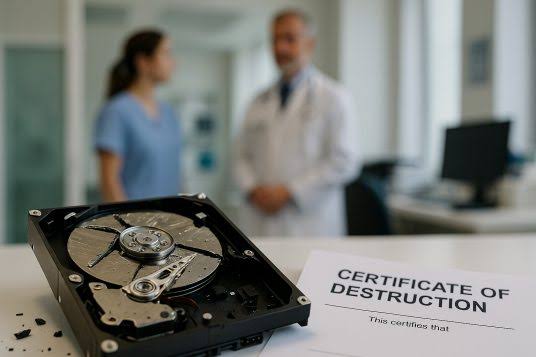
Patient records carry a level of sensitivity that few other types of data can match, covering everything from diagnoses and treatment history to insurance details and personal identifiers. When a hospital or clinic retires an old server or workstation, the storage drives inside often hold years of this information, which is exactly why healthcare organizations need reliable ssd destruction services rather than relying on a standard software wipe before equipment leaves the building.
Why Healthcare Data Carries Extra Risk
Medical records combine several categories of sensitive information in a single file, health details, financial data, and personal identifiers all together. If this data resurfaces after a device is improperly disposed of, the consequences extend well beyond a typical data breach, potentially exposing patients to medical identity theft or insurance fraud that can be difficult to untangle months or years later.
The Insurance Fraud Angle Specific to Medical Records
Medical identity theft carries a particular complication that other forms of identity theft don’t always share, since a fraudulent claim filed under a stolen medical identity can actually corrupt the victim’s own legitimate health records with someone else’s treatment history. Untangling this kind of contamination after the fact is often far more difficult than resolving a typical financial fraud case, which makes preventing the exposure in the first place considerably more valuable than trying to clean it up afterward.
This unique risk profile is part of why healthcare data destruction standards tend to be even more stringent than those applied to general business records, reflecting just how much harder these particular breaches are to fully resolve once they occur.
Regulatory Pressure Around Patient Data
Healthcare organizations operate under strict regulatory frameworks specifically governing how patient information must be protected, including at the end of a device’s life. These regulations typically require documented proof that data was properly destroyed, not just deleted, making destruction records a genuine compliance necessity rather than an optional best practice.
Why Standard Deletion Isn’t Sufficient Here
Solid-state drives store data across memory cells in ways that make simple deletion unreliable, since fragments of a file can persist in cells the operating system no longer considers active. For a healthcare organization handling thousands of patient records across its lifetime, this uncertainty is simply too great a risk to accept when physical destruction offers a definitive alternative.
This technical nuance is often lost on non-technical staff making disposal decisions, which is exactly why a clear written policy matters more than relying on individual judgment calls about what counts as sufficiently secure.
Coordinating Destruction Across Multiple Facilities
Larger healthcare systems often operate several clinics or departments, each generating its own retired equipment on a different schedule. Centralizing destruction through a single trusted provider, rather than letting each location handle disposal independently, creates consistency and makes it far easier to maintain a complete, organization-wide record of what’s been properly destroyed and when.
This centralization also simplifies vendor management considerably, since a single point of contact overseeing destruction across every facility reduces the chance of inconsistent practices developing at individual locations over time.
The Chain of Custody Question
Between the moment a drive is removed from service and the moment it’s actually destroyed, that drive still contains fully readable patient data. A reputable destruction service maintains a clear chain of custody throughout this window, documenting exactly who handled the equipment and when, which closes a gap that’s easy to overlook if destruction isn’t planned carefully.
Balancing Compliance With Equipment Refresh Cycles
Healthcare technology gets refreshed regularly as equipment ages or new systems come online, and building data destruction directly into this refresh cycle, rather than treating it as a separate, occasional task, keeps compliance consistent. Facilities that wait until a storage closet is overflowing with retired drives tend to face a much larger, more stressful destruction project than those who handle it in smaller, regular batches.
Training Staff to Recognize the Requirement
IT staff and administrators moving quickly through an equipment refresh can sometimes overlook the destruction step entirely, especially if a device seems to have been reset already. Clear internal policy, requiring documented destruction before any drive leaves the facility for any reason, removes the ambiguity that can otherwise lead to a well-meaning but risky shortcut.
Periodic refresher training, even a brief annual reminder session, helps keep this requirement top of mind for staff who may only handle equipment retirement a handful of times a year and could otherwise forget the specific steps involved between refreshers.
Final Thoughts
Patient data deserves a level of protection that matches its sensitivity, all the way through the end of a device’s useful life. For healthcare organizations, treating drive destruction as a routine, documented part of equipment retirement isn’t just good practice, it’s a genuine safeguard against the kind of breach that can damage patient trust and organizational reputation for years afterward, long after the original equipment has been forgotten.